There are no words for me to explain.
Even though I have always searched.
Indeed, I have spent my entire life looking.
As a teenager, I read voraciously to find them. I poured through thousands of pages of literature searching for the right words.
And then as an adult, I learned new languages and cultures to find them.
But there have never been any words.
‘It is impossible to say just what I mean!’
There is an impenetrable wall between me and the rest of humanity.
There are no words to describe my pain.
There are no words to explain my suffering.
There are no words to even qualify my existence.
Right now, I am apart from every single person who reads this. Quite literally, in fact, as I am socially isolating.
But back when I was a teenager, I still had friends.
I could hang with the nerds. With the jocks, artists or hedonists.
Even though nobody ever knew me.
Back then, however, I was still a stranger so people did try.
And there was one person who helped me to navigate my lonely struggles more than he will probably ever realise.
We were not even close. I wish I could say thank you now.
He was among my circle of nerd friends and one year he was selected as my secret Santa.
He gave me a book of poetry by T. S. Eliot.
What a fucking brilliant gift!
If anybody ever had the words, for me Eliot came the closest.

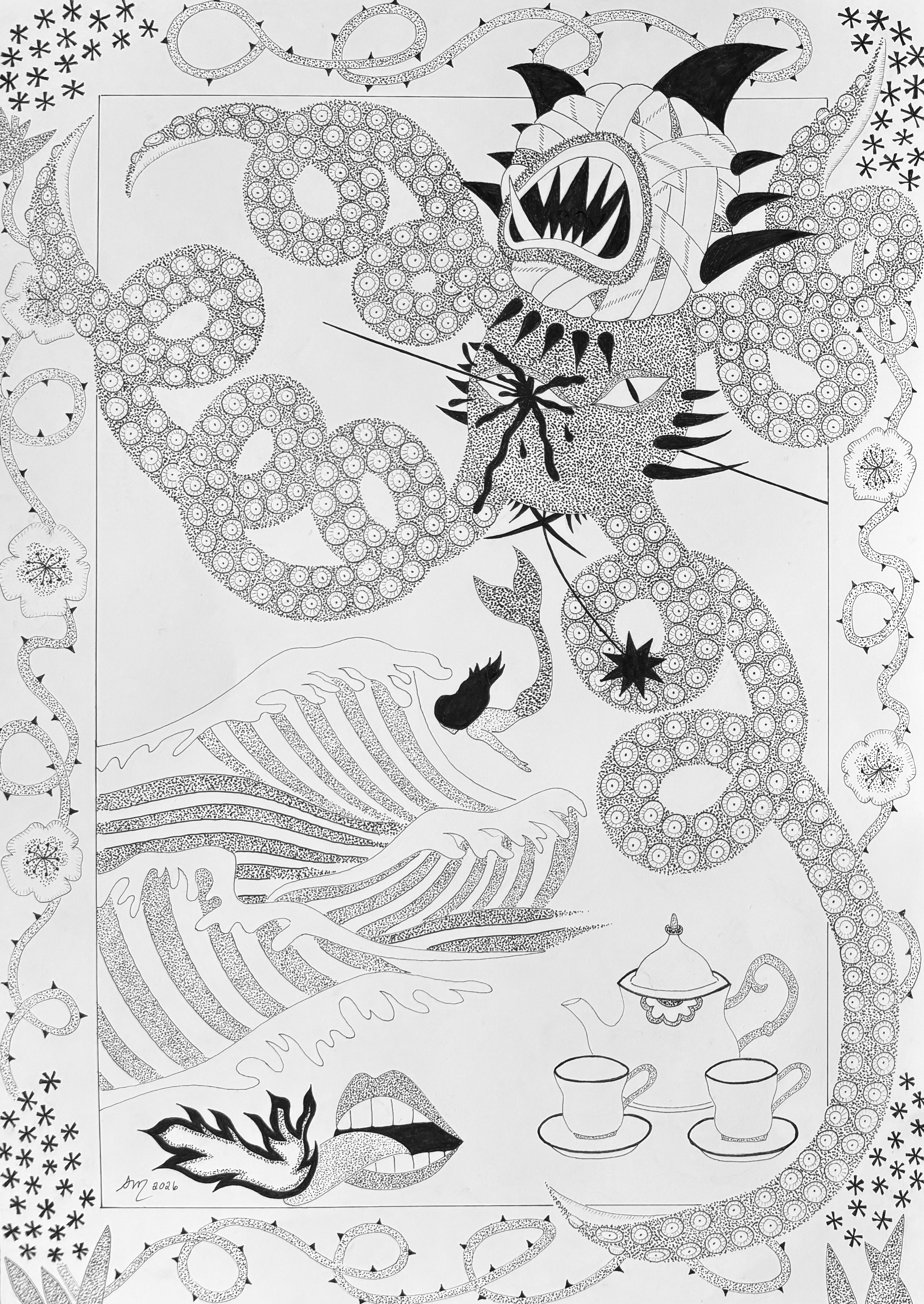
Right now, at this stage of my healing, I feel like a total madwoman. As the nerves begin to release along the vagus pathway, it feels like caterpillars are turning into butterflies inside of my body.
Stuck in the past-present, I feel a multiplicity that is also very angry.
The amount of heat that my body is releasing could probably boil water.
After finishing this drawing, I decided to revisit the short story that I wrote about my experience in Iran to help me process some of my past trauma. I am not at all satisfied with it – it needs to be completely rewritten.
So, why am I publishing it then? Well, for two reasons.
One is that I wrote it for a class in 2008 during my doctoral studies and my so-called women’s studies professor called me an Orientalist because I describe the Iranian official scribbling on scraps of paper as unprofessional.
After almost being detained in an authoritarian regime?
I could not defend myself back then, but what the fuck bitch? What if he was an Arab working for the Israeli Defence Forces? Or a Muslim working for ICE?
That was the most repressive class I have ever taken. I often felt like the class Republican. And I took a course at The New School taught by the asshole who went on to write a book titled The Case for Colonialism.
Indeed, my so-called women’s studies professor shares way more in common with the author of that book, Bruce Gilley, than she realises.
The second, more important, reason is that it actually feels like T. S. Eliot is physically poking at my back and shoulders right now. Similar to the butterflies, this is also what the nerves releasing feels like.
How in the world did I predict that?
A Personal Narrative of Iran: My story about your story about me
by Sarah Marusek
I am not an elegant storyteller. In fact, I cannot even tell a proper joke. Excitement usually overwhelms me, and I fail to separate the story from the telling. Things get all mixed up inside of my head and that ruins the story, so I always prematurely end it.
No, I am simply not good at storytelling.
Which is odd because, throughout my youth, I was an avid reader. The only life I can remember actually living exists within the intersections of the printed word and my imagination. By now I ought to know the art of telling a decent story. Really.
Yet perhaps my inability is not that strange after all, considering the unfamiliar locations of most of the stories I used to read and my absolute discomfort in occupying the space that was supposed to be my home in America, the land of ‘the right’ and ‘the good’.
If I were born about a decade later and to different parents, I probably would have been just another medicated child. My diagnosis would have been obsessive-compulsive disorder with a touch of attention deficit disorder and perhaps even manic depression. The pharmaceutical industry would have surely helped me to tell ‘better’ stories.
So, all things considered, I’m not at all sorry that my life turned out differently. But to make it up to you, I will try to keep my story simple. I only hope that you will believe me.
My story takes place in Iran, during the summer of 2008.
It was a hot Thursday morning in August.
My friend Naghmeh had just driven me to the center of Tehran and dropped me off at the given address. I was tired and running late as usual, but in this case also suffering from an unusually terrible hangover after my goodbye party the night before.
Thankfully, I had refused to take the ecstasy on offer.
However, I was still feeling rather dazed and confused, so even though I did manage to leave the house with my head appropriately covered in a conservative maqna-e, I had forgotten to change out of my flipflops, which are not acceptable footwear in the Islamic Republic.
Out of sorts, I found myself in a dilapidated room, in what appeared to be a high security building. Sitting down, I noticed that my toenails were painted bright red.
I suddenly got very nervous.
The air was close and the walls were cracked. The paint showed signs of wrinkling. I was sitting on an uncomfortable Victorian couch with a cup of tea and a glass of water in front of me.
One Iranian official was seated behind a desk to my left, writing furiously. Another official, this one looking more ominous, faced me and started asking probing questions. There was a translator poised in a chair beside him.
It was supposed to be my last day in the country, and I had been instructed to collect my passport at the police station. However, it took me only a few moments to register that this was not the police station and it was not a bureaucratic meeting at all. I was being interrogated by the Iranian counterintelligence service. And they were not in a good mood.
Apparently, they thought that my fieldwork on social welfare in Iran over my three months visit was a ruse, that my goals were political.
‘Who asked you to do your research?’
The translator repeatedly asked me this question, his words beating in the air ‘like a fatalistic drum.’[1] My back started to hurt, and so I feebly gripped at the pain.
The translator was a skinny and slight man who looked as if he had already decided my guilt. His posture seemed so certain. After conferring with the officials, he said, ‘We do not think that you are here to study Farsi because your language skills are terrible.’
I was offended and scared. I mean, I had only been studying Farsi for one year. And besides, I’m really bad at languages.
When I was a small child, my father was always ill tempered and impatient with everybody, including himself. He frequently used to curse out loud, ‘I’m no fucking good.’ Well, one day I determinedly walked over to him to tenderly protest, ‘Daddy, you are too fucking good.’ I love it when my mum tells me that story. So cute. But I hate it that my father was never able to return the favor.
Suddenly the brooding official demanded, in English, ‘Who do you know in Israel?’
Even though I realised that this was a ridiculous question, I still fumbled for a reply, eventually saying that I did, in fact, have a friend in Israel who worked for a Palestinian NGO.
The official looked embarrassed and the translator changed the subject.
But after about half an hour, the atmosphere became quite tense again. The translator affixed me with his eyes. ‘I am afraid that my colleagues are not happy. They do not believe what you are saying.’ He then paused for a moment, until eventually resuming.
‘Your story does not match our police file on you. We will leave the room to give you some time to reflect. To think about your story. Then, we will come back. If you decide to change your story, then we will return your passport to you and we will allow you to leave Iran. However, if you do not change your story, then we will have no choice but to detain you.’
Wait a second. Even if my father had told me that I was good enough, would I have believed him? Did he ever believe me?
The officials left the room and I began to understand the gravity of my situation. Tears started to flow from my eyes, at first gently.
They knew things about me, that I had interviewed a well-known scholar who was recently jailed and tortured into a political confession. I did not mention this meeting to them, and they were now using that omission against me.
They also knew that I had dinner with the sister of an Iranian professor from an American university. The bastards must have surveilled me. They knew enough about my activities to make me realise that I probably should tell them everything. All of it.
‘And in short, I was afraid.’[2]
My back was hurting badly and by now I was crying quite hard, which made me panic. Was being completely honest really the best way to proceed? Only, I had no choice because I am a terrible liar. I mean, really bad. But what kind of information did they want anyway?
I repeatedly asked the translator, ‘What do you want to know? Please help me. Guide me. Although you are speaking English, I don’t understand what it is that you are saying. I have never been questioned like this before, and I don’t know what it is that you want from me.’
The translator simply replied that they wanted the truth. Their truth. And yet I wanted to ask, what about my truth?
‘So how should I presume?’[3]
At this point, my back pain was so bad that I was sobbing.
Years ago, at a friend’s wedding, my mum was getting frustrated. ‘No. You were always smiling and laughing. You seemed so happy. I don’t believe that you were ever an unhappy child.’ That’s my mum. Back then she couldn’t even say the word ‘sad’ out loud. I tried to tell her that while I was happy at times, I was miserable most of the time. I even tried to remind her of my darkest moments that we both witnessed. However, my mum would not accept any of it. And I was really angry with her. Why did she refuse to see me?
After about fifteen minutes the three men returned, silently taking their seats. I was still crying hard and the air around us was extremely still. Almost arid.
Ashamed of my tears, I was very afraid and could not think properly, so I suddenly burst out that I would jut tell them everything about my interviews. Everything discussed was research, so I started to list the names of the Iranian officials who had met with me.
However, they demanded to know exactly what was discussed at each meeting.
I was a total mess by now and could only clumsily claw at the corners of my memory. As a result, my brain communicated random details of my meetings in rapid succession. This made them even more suspicious and they challenged the innocence of both me and my informants.
‘What does this woman have to do with welfare?’
‘Why did you meet with that former government minister?’
I explained to them that I was interested in placing my research in a cultural context, that to me welfare is more than just an economic condition, but they did not look very convinced.
And then, all of a sudden, I realised that confessing was an absolute betrayal.
Even though my research was innocent, giving them my confession made me a coward. To the officials, I was a spy conspiring with traitors. They broke me that easily.
Crying, I just kept on thinking, ‘That is not what I meant at all.’[4]
My back pain was now stabbing and tears uncontrollable.
So how could I get them to believe me?
There were two officials who seriously doubted my story, although one seemed like nothing more than a busy bureaucrat and I did not find him all that threatening. He was scribbling notes on scraps of paper, which I found rather unprofessional.
The other one, however, was furious. Which is funny because the first time he interviewed me to renew my visa, two months earlier, I had commented to a friend that his face looked kind. I remarked how his eyes smiled. That is always important to me, smiling eyes.
But now his eyes were only flashing anger, although at times his body did not wear this emotion very well. Frustrated with my answers to his questions, at one point he forcefully placed his wedding ring on his thumb and moved it around, awkwardly. He looked kind of like a cartoon.
As for me, I was a total mess. Humiliated and stained with tears. The people I had met in Iran, foreign as well as Iranian, all told me that resisting the authorities was the only way to survive. Showing them your fear or giving them what they wanted only emboldened them further.
However, this was not my country and I did not want to challenge anything except the accusations against my own work and my informants. After all, I had come to Iran to support the Islamic Republic and to help confront American empire.
But I was terrified and just sobbing. I realised that they were not going to ever let me back into the country to continue my research. Everything that I had worked for during the last three years of my masters and PhD was suddenly irrelevant. So, I could not resist them.
I surrendered my computer and my field notes, while at the same time also worrying that I was not protecting my informants by telling the officials the truth.
Three months earlier, when I had arrived alone in Iran, I was also scared.
In the first week, the morality police stopped me in the street for donning a cute little New York dress that they viewed as not quite long enough to be an acceptable lady’s outer covering in public, what is known as a manteau. A policewoman physically grabbed me and started dragging me towards a van, but then they let me go because I was a foreigner.
The following week I was still nervous and simply avoided the squares where the police usually patrolled. Every time a van passed by with that infamous green stripe I shuddered.
And yet, by the third and fourth weeks, after buying the appropriate clothing, I would intentionally walk by the morality police checkpoints just to show them up. I suddenly found them pathetic. Indeed, when I looked around me, most Iranian couples resumed holding hands right after passing the checkpoint. Young women defiantly pushed back their headscarves showing hair overly coiffed and often streaked by peroxide.
And I wondered, who was actually controlling whom?
It was only a few years ago that I started to understand why my mother could not see me. Or, at least, not the way I expected to be seen. I had been so introverted that I had never realised how my pain was entirely my own. As soon as I started letting the world seep into my life, my sorrows blossomed. But ironically, I was no longer as sad. Before this transformation, my mother was merely seeing the person whom she needed me to be, even if it was only partially me. Over time she finally started to see this too.
I thought that I was being a respectful visitor to Iran.
‘Politic, cautious, and meticulous.’[5]
Ouch! My back pain continued to grow in intensity.
I kept on asking myself if I had done anything wrong. Well…?
Yes and no. I was an American and my government was openly hostile to Iran’s government. Washington repeatedly vilified Iran’s leaders without offering any proof, and it never even occurred to Americans to question the culpability of ordinary Iranians, as they were born to be guilty and ‘we’ were born to be good.
But I knew differently. While I was visiting the country, an American-based investigative reporter had uncovered the CIA’s covert plans to finance a velvet revolution in Iran’s outer provinces. So, could I blame these men in front of me for not believing that I loved their country?
I tried to tell this to them over and over again, but ‘It is impossible to say just what I mean!’[6] Especially when the pain in my back was pounding, like somebody fiercely poking at me.
In between my sobs, I made a feeble effort to defend myself.
‘You would think that Iran needed some friends in America,’ I snarled.
The translator’s eye bulged.
I then accused them of not trusting me; however, the translator eventually reassured me that they did. I believed him, and he started to look like he was believing me.
There is a strange intimacy that develops between you and your interrogators. Especially when there are several people in the room and yet only one speaks your language. Perhaps this was their strategy, but I felt like my fate was in the translator’s hands and that he was a good man.
While the others were ransacking my computer files, he was sitting next to me, kindly admiring the notebook I had purchased from an art gallery in central Tehran. The front cover pictured a nineteenth century photograph of Iranian peasant women who looked strong and beautiful.
Together we went through my field notes. And when we reached the back page of my notebook, where Fariba’s sister had written the name Saeed Panter in Persian, the translator asked me who that was with a touch of suspicion. So I gently explained that he was a rapper and the translator then asked me if we were friends. I said no, he just performed at a wedding I went to a few days ago and that he was young, but pretty good.
‘Did you dance at the wedding?’ he queried.
I said yes, we danced all night.
With a nervous smile he leaned forward and quietly whispered, ‘Did you… did you meet anybody special there?’ I immediately exclaimed no!
‘Good,’ he replied looking relieved. I now found his certainty very attractive.
I like dead flowers. Sometimes I hold on to them for months, even years. Not the pressed, pretty kind, but the rotten, ugly kind. Perhaps I inherited this quirk from my grandmother. When she was a young woman, she received flowers at work. After they died, she repackaged them and sent them to a friend. To me, this sounds like a fabulous gift. However, the friend was rather upset.
Around this time, the officials finally agreed to return my passport. They put me in another room to wait for my computer while they deleted all of my field notes.
The furniture and the carpets in this room must have all been brand new, because they reeked of a strong, industrial scent. It made me even more nauseous.
The translator said I could get up and walk around if the smell bothered me. And yet while the stink was truly awful, I could not bring myself to stand up.
Why? Because I was sobbing again. This time not for myself, but for all of the names in my notebook. The kind friends, scholars, officials and former government ministers who had charitably helped me with my research, and whom I ultimately betrayed.
To take my mind off the guilt, I concentrated my attention on the terrible smell. However, it didn’t work. As I continued to sob, the translator gently told me that it was no longer the time to cry, as nothing would be gained from it, and that instead now it was time to relax. He looked at me imploringly and told me again how they were letting me leave the country.
It’s funny how a man can seem so helpless when confronted with a crying woman. I almost thought he wanted to rest his hand on my shoulder to comfort me, an unforgivable act in the the Islamic Republic. Instead, he nervously paced the room.
Shortly thereafter the officials decided to confiscate my notebook, which I told them was not fair, as I had given it to them in good faith to prove my innocence. But the brooding official retorted that he had granted me a visa to study Farsi in good faith, thus it was ultimately I who had acted unfairly. This made me really angry and I told him off.
But had I really been telling the truth on my application? I had always intended to carry out some preliminary research while studying the language.
I was starting to question my own virtue.
By now the interrogation had entered its fifth hour. At this point, there was no longer any time, ‘For decisions and revisions which a minute will reverse.’[7]
My back pain was so intense that I had to turn around and confront it.
And I could not believe my eyes, but a miniature version of the American poet T. S. Eliot was standing behind me, furiously shoving his pointed finger repeatedly into my back.
Ouch, ‘What the hell are you doing that for?’ I fiercely asked him.
He angrily replied, ‘Stop quoting me!’
I was incredulous. I mean, what could he possibly mean? So, I asked.
However, instead of answering my question, he then reached over and started to shake me, like ‘a madman shakes a dead geranium.’[8]
Suddenly, he started screaming at me: ‘I said, stop quoting me. You keep stealing lines from my poetry, taking the words out of context and distorting my verse. Stop that. I said stop!’
Befuddled by the pain in my back, I could not figure out why a miniature version of one of my favorite poets was in the room with me in the Islamic Republic. I mean, wasn’t he long dead? And why was he accusing me like that? What did he mean about stealing his lines? Surely, I was always crediting him. Was he saying that his poetry has only one meaning? That his verse was ultimately bounded, and thus removed from my reality?
What the fuck?
Wait a second… Shit. I forgot to tell you about the culture of crying in Iran, which might have been useful information, and well before now.
Crying had made me feel weak and it broke me.
But there is a strong culture of mourning in Twelver Shi’i Islam, the dominant sect in Iran. The tradition is imagined to date back to the heroic martyrdom of Imam Hussein, the Prophet Mohammad’s grandson, who is one of the Twelve Imams revered by Iranian Shi’is.
Public mourning celebrations continue to be a popular tradition among the faithful in Iran. During the annual commemorations of Imam Hussein’s martyrdom, crying in public is seen as a demonstration of one’s allegiance to the principles of the Islamic Revolution. Also, former Iranian President Rafsanjani is well known for crying during his Friday prayer sermons.
Of course, I am not saying that my interrogators thought that my tears were holy. Not at all. I am only explaining how crying is not always perceived as a sign of weakness in Iran and can even be considered honorable.
Now that we have established that background information, where were we in the story? I don’t actually even remember. Do you?
Okay, well… to wrap it up then, the officials finally returned my computer after deleting all of my field notes and told me that I could leave Iran, although without T. S. Eliot as they wanted to keep him for further questioning.
The no-longer-brooding official walked me outside and even kindly pointed out where my friend Naghmeh was waiting for me. I quickly got into her car clutching my computer, still sobbing.
She asked me what was wrong.
However, instead of letting me answer, she turned on the ignition and speedily drove off. She had only meant to drop me off that morning, but when she saw that there were guards inside the building, she became worried and decided to wait for me. I couldn’t believe it, but she had been sitting there alone in her car, waiting for me, throughout the entire five-hour drama.
Work Cited
Eliot, Thomas Stearns. Selected Poems, (New York: Harcourt Brace Jovanovich, 1964).
[1] ‘Rhapsody on a Windy Night’
[2] ‘The Love Song of J. Alfred Prufrock’
[3] Ibid
[4] Ibid
[5] Ibid
[6] Ibid
[7] Ibid
[8] ‘Rhapsody on a Windy Night’