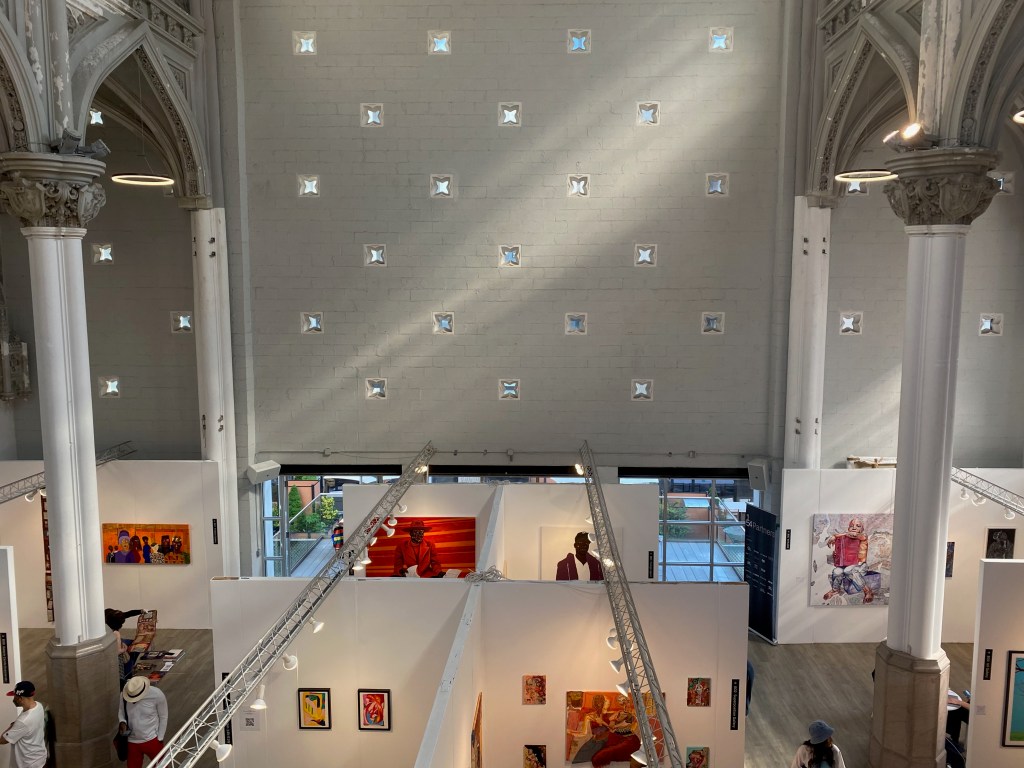
I recently attended the 1-54 Contemporary African Art Fair in Harlem, New York and was absolutely blown away by the quality of art on show. First launched back in 2013, 1-54, the leading international art fair dedicated to contemporary art from Africa and the African diaspora, now takes place annually in the cities of Marrakech, New York, London and Paris. Due to the Covid pandemic, however, last year’s fairs were virtual and this year’s event in Marrakech had to be postponed. Thus, I felt quite lucky to be able to travel down to New York City for a truly enjoyable art experience. Here, I want to share a selection of some of my personal highlights.
This year, a number of galleries were able to exhibit their collections for the first time, after 1-54’s previous restrictions preventing virtual or travelling galleries were lifted, arguably making it a more decolonized space. New exhibitors this year included nomadic and online Cierra Britton Gallery, “the first NYC-based gallery dedicated to representing BIPOC womxn artists whose work contributes to the contemporary cultural dialogue across the globe,” and Medium Tings, “a roving gallery and project space for art and dialogue, centering around black artists.”
The main draw, for me, was seeing in person the work of late Mozambican-Italian painter Bertina Lopes, represented by Richard Saltoun Gallery, based in London and Rome. Born in 1924 in Mozambique to a white Portuguese settler father and an indigenous Ronga mother, Lopes embraced both sides of her identity; writing for MOMA, scholar Nancy Dantas describes her as “a cosmopolitan bi-racial modern woman”. Lopes was fortunate enough to access a formal Portuguese education, but without losing her culture, a mix of African, European, Indian and other Asian influences. Her art reflects this unique diversity, allowing her to create something entirely new. Indeed, according to the Archives of Women Artists Research and Exhibitions, Lopes “is considered the mother of contemporary African painting”.
Lopes worked closely with the anti-colonial resistance to liberate Mozambique, activities that eventually forced her into exile—first in Portugal, where she was still targeted for her politics, and then finally in Rome, where she remained and continued to produce non-commercial art. According to the press release for her solo show in Rome held earlier this year, “Lopes covered a vital role in the capital, later serving as the cultural attaché of her country’s Embassy. Her rooftop apartment was famous for its dinners hosted with her husband Francesco Confaloni; a salon for African and European diplomats, journalists, and intellectuals.”
Two of her paintings were on view at 1-54. The first, Omaggio a Venezia [Tribute to Venice], was painted in 1975 and is a mesmerizing burst of colors, lines and shapes. The multiple layers of boldly linear paint strokes give the work an electric vibe, portraying the possibility of an enchanted urban city of yesterday, today and tomorrow. This painting reminds me of the novel Invisible Cities by Italo Calvino, revealing the many hidden possibilities that Venice has to offer.
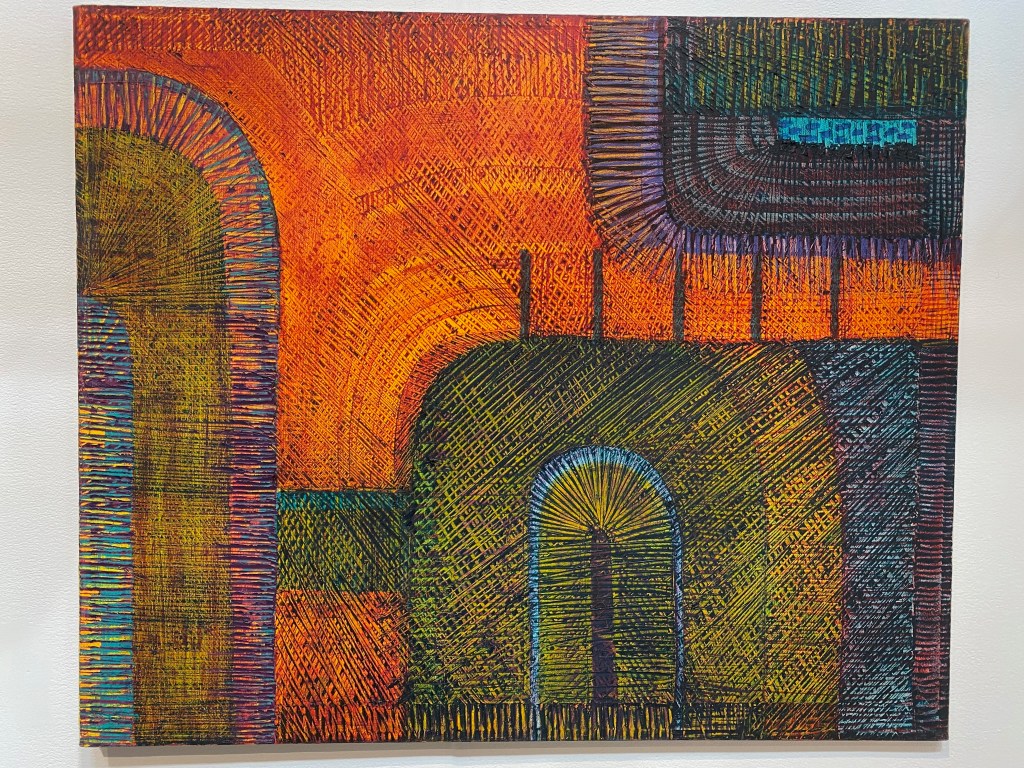
The second work, Untitled, was painted in 1977 and is a whirl of colors full of dizzying movement. Here, the lines are mostly curved, creating what almost looks like a series of eyes that offer new insights into the human psyche. Another visual that comes to mind is that of Sufi Dervishes whirling, a practice of profound meditation involving spinning one’s body in repetitive circles to realize a higher truth.

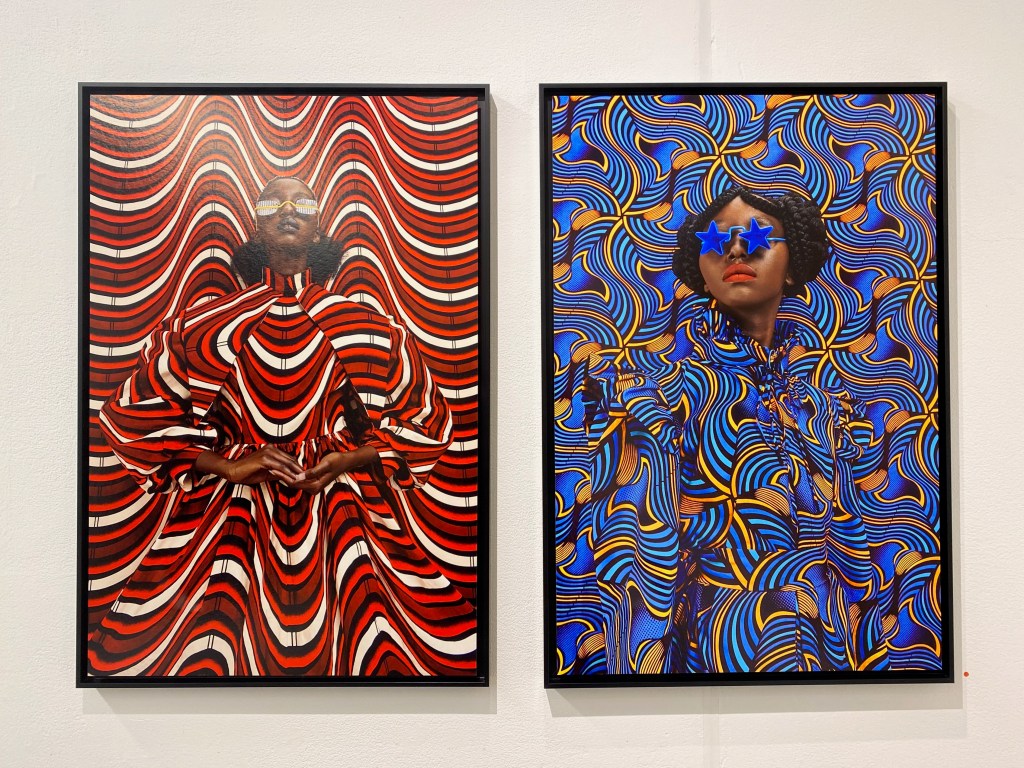
Another highlight of 1-54 was the Camo series by Kenyan photographer Thandiwe Muriu, represented by 193 Gallery in Paris. According to her website, Muriu is self-taught, born and raised in Nairobi, where she currently works and teaches workshops. Her photographs are heavily stylized like fashion shoots, somehow both playful and symbolic. The models are wearing upcycled accessories, giving new life to discarded everyday objects, such a bottle caps and hair rollers. In this remarkable series, she turns the trompe-l’œil technique on its head; the human forms in these photographs are nearly swallowed by the geometric African fabric patterns in the background and on the body. Muriu told the BBC that the series is “a little bit of a personal reflection on how I felt I can disappear into the background of my culture. And my experience as a commercial female photographer was realising that very quickly – because of the cultural context – I can be dismissed and disappear.”

I was also captivated by the work of Kenyan artist Elias Mung’ora, represented by Montague Contemporary, based in New York. According to the gallery, Mung’ora’s paintings are a reflection of the fragmentation of the urban landscape in Nairobi, where he resides. He uses acrylic and photography transfers to uncover the now hidden pasts of these spaces, also exposing their contemporary imbalances. As Artnet astutely comments about Mung’ora’s recent work:
After the global experience of the pandemic over the past year, the works certainly rattle memories of collective urban spaces as places of gathering and communication, rather than as spaces for concern and alarm. Within the political context of Nairobi, however, these works speak specifically to the ongoing social fracturing occurring under a ruling elite that has privatized these important social spaces and truly forced people into their homes. Mung’ora’s works are a reminder of the power of collective action in the face of oppression, and of the quiet beauty of community.


I also have to mention the poignant work of Roméo Mivekannin, represented by Galerie Eric Dupont in Paris. Born in the Côte d’Ivoire, he now lives between Benin and France. According to The New York Times, Mivekannin’s great-great-grandfather was the king of Dahomey, a kingdom in western Africa (now Benin) whose treasures were looted by French colonial forces. The newspaper notes:
He is a major figure not just to his relatives, but to people all over Africa, according to Gaëlle Beaujean, who oversees the Africa collections of the Quai Branly and wrote her doctoral thesis on the Dahomey treasures. Because the king ran a powerful army of male and female warriors and allied astutely with France’s rival European powers, “it took the French a long time to colonize Dahomey,” she said. When French forces finally advanced on the king’s palace in Abomey, he set it ablaze, and fled north to organize a resistance.
Cécile Fakhoury, Mivekannin’s gallerist in Abidjan, Ivory Coast, told the newspaper that the artist also felt a kinship with Black people who were the descendants of slaves. In fact, Mivekannin’s work at 1-54 commemorates a transatlantic narrative of resistance, namely that of late sociologist and activist W. E. B. Du Bois. At the time of the fair I was reading The Souls of Black Folk and so I was especially drawn to Mivekannin’s portrait of the late bel hooks, whose writing and activism has also inspired so many decolonial scholars. Using elizer baths, acrylic and serigraphy on free canvas, Mivekannin places the image of hooks over a passage from Du Bois’s seminal work, creating both a tribute to these intellectual icons and a troubling reminder that racism is still so dominant in American society and politics.

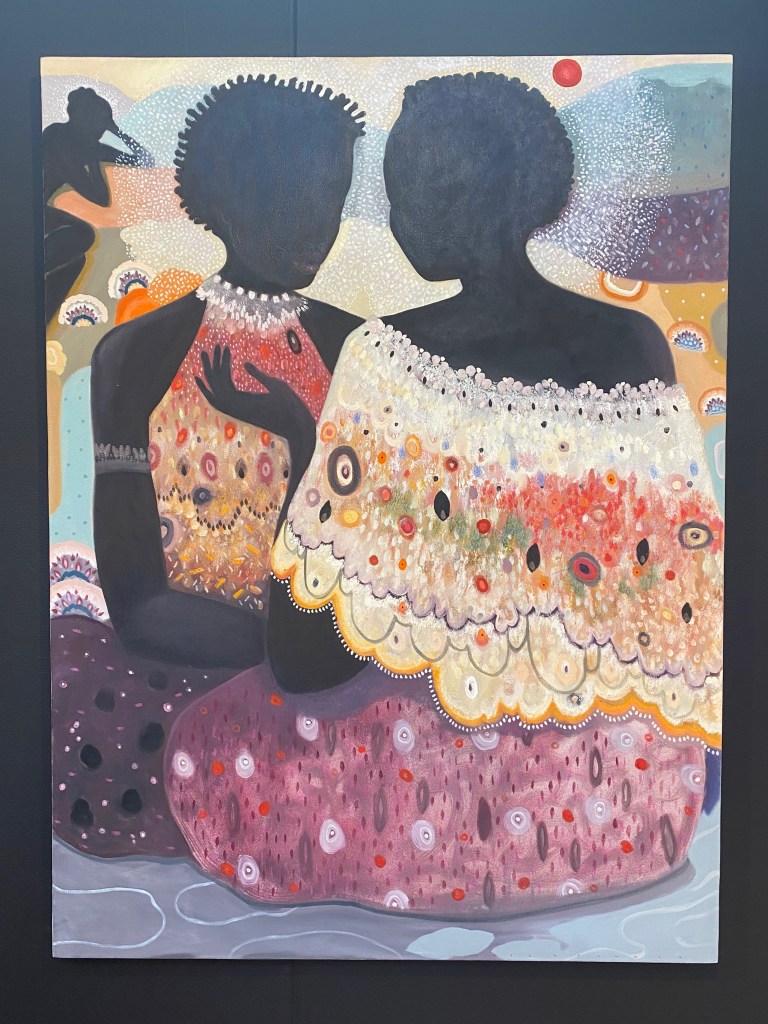
And finally, the paintings of Native American-South African artist Leila Rose Fanner, represented by Galerie Carole Kvasnevski, also in Paris, provided a much appreciated dreamscape to immerse oneself in. Her work really is quite magical; according to her website, Fanner is inspired by spirituality, Art Nouveau and the patterns all around us. She says that her work “depicts ‘the gentle, natural feminine presence, the spirit of Mother Nature or the essence of the Soul”. I totally agree.
 Dr. Sarah Marusek
One response to “Review: 1-54 Contemporary African Art Fair”
Thank you, Sarah, for mentioning my work along with these truly exceptional artists.
I hope to be able to come to the USA to attend my next show – a solo in September at Band Of Vices Gallery, Los Angeles.
I appreciate your kind words. – Leila
LikeLike